“Today, I’m very proud to call myself Iranian, even though it was something I was ashamed of as a child”
Article by: Amalie Jia Barner Ibsen
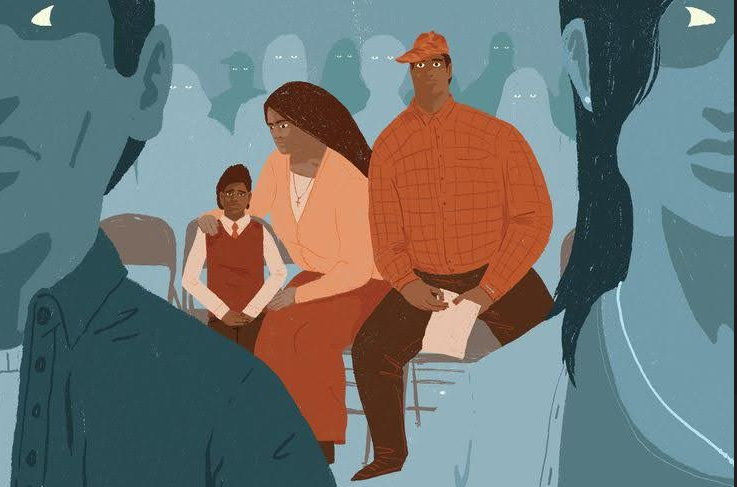
Author’s note: This article is written in the context of an increasingly polarized debate on immigration and integration in Denmark. It aims to create space for reflection on how we approach these debates and show how they are experienced by those who live at the center of them. The conversation centers on a close friend of mine. For privacy reasons, she has chosen to remain anonymous and will be referred to as S throughout the article.
The political debate on immigration has become a constant background noise in my daily life.
It is there when I wake up and turn on the morning news. It follows me on the radio on my way to school and resurfaces on campus as student organizations, for the tenth time this week, debate whether or not to close down our “quiet rooms”. It continues in my classroom, as our professor asks us to connect class material to real-world debates. It is all filled with the same discussion on who belongs and what defines successful integration.
Even when my classes end, the debate continues to follow me all the way home. On the metro, I overhear conversations about immigrants, some more intense than others. At home, I reach for my phone to ease my mind. However, for a long time, my social media feeds have been overflowing with the same hostile rhetoric and political messages from parties, each claiming to have the solution to fix our country.
Since the large influx of refugees in 2015, the topic of immigration has rarely left the headlines. And today, in 2025, exactly a decade later, the debate still remains as present and as heated as ever.
In a recent speech to Parliament, the Danish Prime Minister Mette Frederiksen vowed to continue the fight against immigration in the name of justice, a phrase now firmly embedded in Danish political language:
For many people, including myself, statements like these are often passed off as just another political remark. But for others, they could carry a different weight.
After years of hearing these debates, I began to wonder how they are experienced by those who are most often spoken about, but rarely spoken with. To explore this, I turned to S.
Growing up between two cultures
S was born and raised in Denmark, the child of Iranian parents who fled the country during the civil war. She grew up in central Jutland, navigating life between the traditions of her family home and the expectations of Danish society outside it.
For much of her childhood, this balancing act created uncertainty.
Her home in Viborg was, in many ways, ordinary. S lived with her parents and younger sister. After school, the sisters returned to a kitchen filled with the scent of home-cooked food before the family sat down to eat together. Yet alongside this sense of belonging, S recalls feeling different.
“As a child, I found it extremely difficult to understand what an ideal family is supposed to look like. I often noticed that all my friends’ mothers worked, while mine stayed home to care for my sister and me. It was quite different from how our family functioned, almost like we did not do it right.”
That feeling followed her into school.
“It often felt like there was a difference between the Danish girls and me in my class. I wasn’t proud to say I’m Iranian, almost like there wasn’t room for who I am.”
When I asked whether this feeling came from how others treated her or from something more internal, she reflected.
“It might have been rooted in the insecurity of not being understood.”
A decade of tightening immigration policy
Although S was born in Denmark, she still feels the weight of the political discussions on immigration. For many Danes with immigrant backgrounds, conversations about integration often create a lingering sense of alienation, even when they view Denmark as their home.
That sense has intensified over the past decade, as Denmark has introduced some of Europe’s toughest immigration laws.
In 2016, Parliament passed a bill allowing authorities to search refugees’ clothes and luggage in order to seize cash and jewelry to cover living costs while their claims were being processed.
Two years later, parts of Denmark’s so-called “anti-ghetto” law were reviewed by the European Court of Justice. The law targeted neighborhoods where more than half of the residents have non-Western backgrounds, and opened the door to forced relocation, heavier policing, and the demolition or sale of public housing.
By 2021, the EU raised further concerns over Denmark’s plans to process asylum seekers outside Europe, warning that such measures could violate the principle of non-refoulement and undermine the basic procedural rights designed to protect them.
Last year, the debate took another step. Social Democrat spokesperson Frederik Vad argued in Parliament that even well-integrated immigrants could pose a risk to Danish society:
“Work, education, housing, membership in associations, and a clean criminal record are not enough if one also uses one’s position to undermine Danish society from within, “ he said in Parliament.
Referring to a Swedish crime prevention report, he continued,
“Tens of thousands of people in clans and gangs and in certain ethnic environments have infiltrated, and I quote: all significant sectors of Swedish society. This applies across the private, municipal, and state sectors, including civil servants, caseworkers, prison officers, and dock workers. We are not Sweden. Denmark is different. Yet the culture highlighted in this report is also present here at home.”
While politicians frame these measures as necessary for protecting Danish society, the rhetoric often lands differently for those on the receiving end. The rhetoric shapes perceptions, reinforces stereotypes, and makes people from immigrant backgrounds feel under constant scrutiny.
S says she has felt the shift clearly.
The consequences of hostile rhetoric
Political statements do not stay confined to Parliament or opinion pages.
For S, they also shape everyday experiences.
“It affects me deeply to constantly hear stories where people like me are discriminated against, even though we were born and raised here.
It sends a clear message that we are viewed as guests and not part of Denmark or the Danish society. Instead of talking about Denmark as one country and addressing social challenges together, politicians divided us into two groups.”
She describes a debate that increasingly divides society into us and them, rather than addressing shared challenges together.
And the consequences are tangible. S recounts how her younger sister was subject to racist language at work.
“My sister experienced a very unpleasant situation with an elderly couple at her job, who called her a perker. It’s not uncommon for her to experience this,” she explains.
Online spaces reflect similar patterns. A national survey by Trygfonden earlier this year found that on average, around 11,000 hateful comments aimed at people of Middle Eastern background are posted every month in Denmark. These numbers illustrate how political rhetoric filters into daily life, amplifying the very real feelings of exclusion and discrimination that S describes.
Still, S remains hopeful.
S believes that growing up between two cultures can also be a strength.
“I understand that many Danes are genuinely concerned about the future – I completely get that.
However, I believe the way forward is to face these challenges together. There should be room for everyone who respects and values Danish culture and norms, and I firmly believe that’s possible,” S concludes.
Over time, S learned to embrace both cultures, rather than choosing one over the other.
“Today, I’m very proud to call myself Iranian, even though it was something I was ashamed of as a child,” she says.
What S experience points to a wider lesson. Denmark’s approach to integration has resulted in placing all immigrants under the same microscope, creating distrust and unintended alienation. Instead, the conversation should shift toward addressing social challenges together as a shared responsibility.
Ending Reflections
Integration is not just a problem that needs to be solved on paper. It is lived every day by real people. Behind the heated debates are individuals like S who navigate multiple languages, traditions, and expectations while trying to find their place in society. They are part of the workforce, part of the community, pay taxes, and follow the law, yet their belonging is still questioned.
I strongly believe we need to stop treating integration as a simple pass-or-fail test, where someone is either fully integrated or not. Building a future that embraces difference requires focusing on mutual understanding and respect, not rigid labels.
Many of us, politicians and citizens alike, want the same things: a safe country, healthy communities, and a society where people look out for one another. Moving toward these shared goals requires dialogue, empathy, and policies that unite rather than divide. We must build mutual understanding.
If Denmark wants to build a future with room for difference, the conversation on integration must not begin with suspicion but with trust.
Andersen Nielsen, S., & Mortensen, E. (2025, December 2). Omdiskuterede “bederum” er lukket – nu vil studerende demonstrere. DR. https://www.dr.dk/nyheder/indland/omdiskuterede-bederum-er-lukket-nu-vil-studerende-demonstrere
Day, K. (2016, January 12). Denmark to seize refugees’ valuables. POLITICO. https://www.politico.eu/article/denmark-to-seize-refugees-valuables/
Frederik Vads tale i Folketinget om udlændingestramninger. (2024, April 5). Dansketaler. https://www.dansketaler.dk/tale/frederik-vads-tale-i-folketinget-om-udlaendingestramninger
Mellersh, N. (2025, August 1). Denmark’s EU presidency puts migration reform center stage. Infomigrants. https://www.infomigrants.net/en/post/66133/denmarks-eu-presidency-puts-migration-reform-center-stage
Statsministeriet. (2025, October 7). Statsminister Mette Frederiksens tale ved Folketingets
åbning den 7. oktober 2025. https://stm.dk/statsministeren/taler/statsminister-mette-frederiksens-tale-ved-folketingets-aabning-den-7-oktober-2025/
TrygFonden: Angreb & Had i den offentlige debat på Facebook. Marts 2025.
Hello, yes this article is actually nice and I have learned lot of things from it regarding blogging.
thanks.