Too Strong to be a Woman: The Dangers of Transvestigations in Sports
Article by: Maja Christiansen Cawthra
Image: (Richard Pelham / Getty Images)
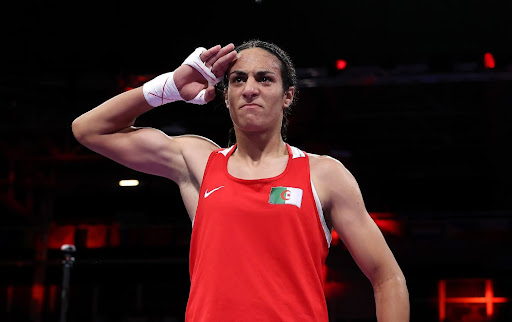
Back in the summer of 2024, with eyes across the world tuning in to the Olympics, outrage was sparked in women’s boxing following the victory of Algerian boxer Imane Khelif over Italian boxer Angela Carini. The match lasted only 46 seconds before Carini tapped out. Her coach claimed that Carini was in so much pain after being punched by Khelif.
From there, a fiery narrative emerged, fanned by prominent figures such as re-elected U.S. President Donald Trump and Vice President J.D. Vance, alleging that Khelif was “secretly a man.” The narrative became so pervasive that The Boston Globe mistakenly published a headline calling Khelif a “transgender boxer” (later apologizing and correcting the error). In reality, Khelif is not transgender, nor is she secretly a man. She was born female and raised as a woman. She has competed in women’s boxing for years, and was cleared by the International Olympic Committee (IOC).
While she had previously been disqualified from the 2023 Boxing World Championships by the International Boxing Association (IBA) for elevated testosterone levels, which can occur naturally in women, the IBA is no longer recognized as the international boxing federation, having long been marred by scandal and controversy. The IBA also refused to disclose what tests were performed on Khelif, stating only that they were “trustworthy” and “independent.”
Khelif is far from the only athlete to have been accused of secretly being a man. An infamous example involves Caster Semenya, the South African middle-distance runner, who, following her gold medal victory in the 2009 World Athletics Championships, was subjected to sex verification tests due to her appearance and ability. After being cleared, she went on to win a gold medal at the 2016 Olympics. However, in 2019, new World Athletics rules required Semenya to take medication to lower her naturally occurring high testosterone levels in order to compete. She refused and sued World Athletics for discrimination.
At the 2020 Olympics, Semenya, alongside five other African runners (Christine Mboma and Beatrice Masilingi from Namibia, Aminatou Seyni from Niger, Margaret Wambui from Kenya, and Francine Niyonsaba from Burundi) were all withdrawn from their events (400m and 800m) for not meeting eligibility regulations based on their naturally occurring testosterone levels and appearance.
This trend, dubbed “transvestigating,” has been around for decades but has gained much more attention in recent years, particularly regarding women’s sports. The term combines the two words ‘transgender’ + ‘investigation’ and is defined by, LGBT+ organization, Eagle as: “the informal discriminatory investigation into whether a person is secretly transgender (usually assumed to be trans women), generally conducted by analyzing that person’s appearance and anatomical structure.” The trend has even influenced anti-trans laws in the U.S., with at least 27 states passing laws banning transgender youth from participating in school sports.
In February of this year, Trump signed an executive order titled Keeping Men Out of Women’s Sports. The order states: “Many educational institutions and athletic associations have allowed men to compete in women’s sports. This is demeaning, unfair, and dangerous to women and girls, and denies women and girls the equal opportunity to participate and excel in competitive sports.” The order withdraws federal funds from educational or sports-related programs where ‘men’ are allowed to compete against women, arguing that this deprives “women and girls of fair athletic opportunities, endangers them, humiliates them, and deprives them of privacy.”
Here, it is clear that the prevailing argument around transvestigating centres on the supposed ‘unfairness’ and advantage that higher testosterone levels provide in competition — inherently implying that male biology is ‘better’ than female biology and that allowing ‘men’ to participate with women endangers them. These arguments of ‘unfairness’ being justified through the language of science is far less definitive than these policies suggest.
Genetic Differences: Celebrated or Penalized
The argument that testosterone provides a competitive advantage has long been accepted as a universal truth in sports.
Since 2015, the IOC has limited testosterone concentration in female athletes to less than 10 nmol/L (nanomoles per liter) for at least 12 months prior to and during competition. No threshold exists for male athletes, and there is an ongoing discussion about decreasing this limit to 2.5 nmol/L. Testosterone levels can vary for many reasons, the average female range is typically between 0.5 and 2.4 nmol/L. While scientific studies on testosterone levels show some correlation between higher testosterone and improved sports performance, particularly in sprinting, it is important to point out that the scientific community does not fully agree on these regulations, nor on the assumption that testosterone alone determines athletic performance. The notion that testosterone provides a straightforward competitive advantage becomes far more complicated under closer scrutiny.
Many cisgender women naturally produce elevated androgens (male hormones). For instance, 8–18% of women of reproductive age have polycystic ovary syndrome (PCOS), a condition that results in higher-than-average testosterone levels.
Moreover, transgender girls who begin puberty blockers early often have testosterone levels comparable to or even lower than those of cisgender women. With Joanna Harper, a medical physicist at Loughborough University in the UK stating: “Trans women as a population group are taller, bigger, and in an absolute sense stronger than cis women. However, after going through hormone therapy, trans women are now moving their bodies with reduced aerobic capacity, reduced muscle mass.” She also points out that trans people often struggle with poorer mental health, due to prejudice, which should not be underestimated as a component of athletic performance. These examples challenge the idea that all trans women retain a biological edge, highlighting how the boundaries of “natural” advantage are neither fixed nor evenly applied.
Indeed, biological variation is an inherent and celebrated feature of sport. Michael Phelps, nicknamed “The Flying Fish,” is the most decorated and successful Olympian of all time. With a wingspan three inches longer than his height (he stands at 6’4” with a 6’7” wingspan), hyperextended joints, double-jointed ankles, size 14 feet, and unusually high lung capacity, Phelps’s physiology gives him undeniable advantages — yet these are viewed as natural gifts rather than unfair advantages. This contrast raises a critical question: Why are certain biological differences glorified in men’s sports but penalized in women’s?
This inconsistency becomes even clearer outside physically demanding sports. In chess, for example, no testosterone-based barriers exist, yet gender divisions remain. In 2023, the International Chess Federation (FIDE) “temporarily” banned transgender women from competing in women’s events, claiming that individual cases required further analysis that could take up to two years. Trans players could still compete in open tournaments, but the decision sparked widespread criticism. UK MP, Angela Eagle, who jointly won the 1976 British Girls Under-18 Chess Championship, stated: “There is no physical advantage in chess unless you believe men are inherently more able to play than women. I spent my chess career being told women’s brains were smaller than men’s, and that we shouldn’t even be playing.” FIDE also announced that trans men who previously held women’s titles would lose them.
Taken together, these examples reveal that the debate around inclusion in sports cannot be reduced to biology alone. Instead, they expose how ideas of “fairness” are filtered through social and cultural biases, namely, the misogynoir nature of these “investigations” and exclusions.
“Transphobia in Sports is about Sexism; it’s about the Regulation of Female Bodies and the Celebration of Male Bodies.”
Quote from Leo Ross for the Oberlin Review
As discussed, the ongoing debate about trans inclusion in sports positions itself around the notion of ‘fairness’. Yet, as many feminist and queer activists and scholars have long noted, fairness in sports is shaped by gendered assumptions. The very idea of who deserves to compete, and what kinds of bodies are considered acceptable, is not neutral.
Women athletes, whether cis or trans, have needed to navigate a double bind between athletic achievement and social expectations of femininity. Trans athlete, Leo Ross, shared in The Oberlin Review: “When I was a student on the Oberlin women’s basketball team, I saw many in the female athlete community struggle with eating disorders, exercise addiction, and body image issues. These athletes were stuck between male desirability and athletic success. They had to craft a body that was both competitive and conventionally desirable — two things often at odds with each other.”
This reveals that the issue is not simply about physical performance, but about appearance and the ongoing demand for women’s bodies to conform to narrow aesthetic ideals. To be ‘too’ muscular or ‘too’ fast risks being seen as not ‘woman enough’. As Ross writes: “Teammates who were deemed too tall or too strong or too fast were penalized disproportionately. What should’ve been seen as a competitive advantage was read as inherently unfair.”
Such examples show that what is celebrated as dominance or superiority in men’s sports is often viewed as transgressive or illegitimate in women’s sports. As the Egale notes: “Athletes who are men are often afforded an unlimited range of athletic prowess. Men can only get better — they are encouraged to break records and surpass limits. If a man greatly outperforms his competitors, he is a champion; if a woman does, she is often subject to scrutiny and transvestigation based on the assumption that her achievements are only possible because she is secretly a man.”
This double standard makes clear that the issue is not one of fairness or biology but of patriarchal discomfort with gendered strength. The suspicion directed at both trans athletes and women who excel reflects a long history of tying athletic legitimacy to conformity with fragile ideals of masculinity and femininity. Black women are often more at risk for transvestigations, “especially those who are the complete opposite of the feminine ideals and beauty standards that white men have placed in society,” according to Daniel Raygoza’s opinion piece for Echo.
Black trans women face some of the highest levels of transphobia. A 2011 U.S. study, Injustice at Every Turn: A Report of the National Transgender Discrimination Survey, found that “from education to employment and housing discrimination, from police brutality to health care disparities, Black transgender people are suffering at extremely high rates due to bigotry and transphobia. Nearly half of all Black transgender respondents reported being harassed at work and at school.” Throughout this article, we have seen how the athletes that get the most attention and scrutiny are often women of colour, with arguments on their appearance being ‘man-like’ making a dominant appearance.
It is also clear that this debate centres overwhelmingly on women’s sports. Men’s sports face nowhere near the same scrutiny. For example, in 2023, transgender boxer, Patricio Manuel, defeated a male opponent in a professional fight. Although the victory attracted attention, much like Khelif’s victory did, the discussion did not revolve around a supposed biological advantage. Instead, there was disbelief that Manuel could win at all. Popular podcaster, Joe Rogan, remarked: “My first thought was: this guy’s going to get lit up if he fights actual men. That’s a female-to-male…I haven’t sparred in forever — I’ll knock that dude the f*** out.” Rogan’s comments suggest that even when trans men compete against cis men, their abilities are dismissed as lesser or not “real.”
This double standard highlights how gendered expectations shape the treatment of trans athletes across categories: while trans women are portrayed as “too strong,” trans men are framed as “not strong enough.” In both cases, their legitimacy as athletes is questioned. Such contradictions reveal that efforts to exclude trans people from competition are not protective but regressive. As Ross writes: “To exclude trans women from sports is to validate all the men who claim women’s bodies aren’t good enough. It changes nothing about the rampant sexism in women’s sports and does everything to reinforce it… Because women of all experiences, cis or trans, should never have to prove that their body is ‘woman enough.’”
Redefining Fair Play
Ultimately, the debate over trans inclusion in sports is not simply about competition or fairness, it is about who is allowed to belong, to succeed, and to be believed. Transvestigations and exclusionary policies harm not only transgender athletes but all women, reinforcing narrow, patriarchal definitions of what a “real” woman’s body should look like or be capable of.
If fairness is truly the goal, then fairness must mean equity, ensuring that all athletes, regardless of gender identity or biology, are treated with dignity and respect. This would require sports institutions to base policy on credible, transparent science rather than fear or politics, and to recognize how racism, sexism, and transphobia intersect in the policing of bodies. Education, representation, and solidarity are crucial. By challenging the supposed truths behind gender and athletic ability, we are able to create spaces where diversity in athletic excellency is celebrated rather than questioned.