Climate change, peace, and security: Why climate change is not only an environmental concern
Written by: Maja Christiansen Cawthra
Edited by: Ana Karina Oliva
Photo by: Sophie Berg Gertsen
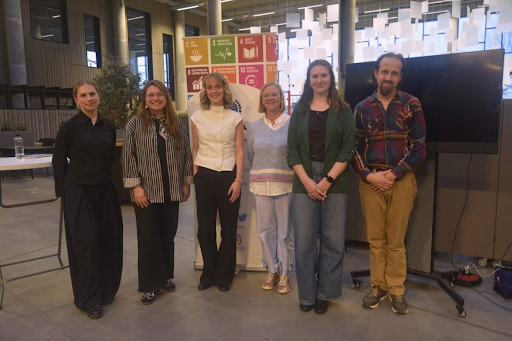
At UNYA Aalborg’s recent event on climate change, peace and security, the central message was clear: Climate change cannot be continued to be treated as a distant solely environmental concern, but rather a force that is already shaping security, conflict and law in ways that demand a broader and interconnected response. This event brought together three experts from different fields to explore why this relationship with climate change is so complex, with focus being on how interconnected climate change is to current and future instabilities, security risks and conflict.
The three speakers were: Bárbara Magalhães Teixeira, a peace and conflict researcher at SIPRI (Stockholm International Peace Research Institute) with work which focuses on the intersections between nature, conflict, and peace; Christina Tvarnø, a professor in International, Climate & EU Law and Kristian Kongshøj, who lectures at Aalborg University in political sociology, with focuses on climate, environment, sustainability, and political economy.
Throughout the panel discussions, the focus always remained on the indirect pathways through which climate change affects instabilities. From food shortages, displacement, loss of livelihoods to general social stress/unrest, all being sources of insecurity and conflict. This article will delve into these indirect pathways brought up during the event as well as consider the steps to take to tackle climate change.
Why climate security is an inequality issue
A central discussion during the event reflected on how global climate security cannot be separated from deep inequalities between the Global North and the Global South. As Kristian Kongshøj noted, wealthy nations maintain their economies through resources and labour extracted from less wealthy regions, a dynamic that continues to shape climate vulnerability.
Continuous research shows that per capita consumption remains vastly higher in the Global North, with the Global North being responsible for 92% of excess global carbon emissions. The US alone accounts for 40% and the European Union for 29%. These findings illustrate an “atmospheric colonisation”, where many countries with disproportionate responsibilities “relied on the appropriation of labour and resources from the Global South for their own economic growth, they have also relied on the appropriation of global atmospheric commons, with consequences that harm the Global South disproportionately.” Quantifying national responsibilities for is important as with more and more damage caused by climate change, who is liable?
Bárbara Teixeira further emphasized on how this imbalance reflects historical responsibility: nations least responsible for the proxy crisis are often the ones facing its most severe consequences. This asymmetry isn’t just an ethical concern, it’s a source of insecurity. When climate impacts undermine food systems, increase migration flows, and destabilize governments, the fallout endangers global stability as much as local livelihoods.
Furthermore, the panel also connected climate injustice to gender. As observed, environmental and climate harms often intensify existing inequalities, and women and girls frequently face greater risks in climate-effected settings. In many regions, women are responsible for securing water, food and fuel for their families, and when these resources become scarce due to changing climate conditions, women must work longer hours, and travel further. Increasing their workload significantly and cutting into time for work, education and rest.
However, as was brought up by Teixeria, men as also not exempt from gender roles, with many men having the societal expectation of being the provider for the family they are often the first to migrant before their families, taking routes where they risk their lives.
Law, governance, and the limits of regulation
Christina Tvarnø’s contribution brought a rigorous legal lens to the panel discussions, underscoring that international climate law remains both essential and constrained. Agreements like the Paris Agreement have symbolic and procedural value, but their reliance on voluntary commitments, and lack of enforcement mechanisms limit their effectiveness. The discussion revisited the earlier principle of common but differentiated responsibilities, contrasting it with the Paris Agreement’s equal treatment of all states, an approach that obscures historical inequalities and weakens accountability.
Tvarnø continued to highlight how these shortcomings are most visible in global commons such as the ocean. Rising sea levels, ungoverned maritime zones, and climate-driven displacement reveal the fragility of international frameworks not designed for planetary-scale change. While law can define responsibility and legitimacy, it cannot be a substitute for political will. For that reason, the COP process, despite its flaws, remains indispensable, as one of the few cases where distributional questions of responsibility, finance, and power are openly negotiated. Nonetheless, the three speakers agreed that legal instruments are not enough to close the gap, public pressure and financial commitment from the Global North is needed.
Energy, militarization, and geopolitical tension
Energy surfaced as one of the debate’s most urgent and politically charged themes. Barbara Teixeira argued that militarization and fossil dependency form a mutually reinforcing cycle: global rearmament due to current conflicts and tensions diverts resources away from climate adaptation, with weapons, transport etc. all relying on fossil fuels. The defence sectors remain among the largest unregulated emitters.
An example that fleshes out Teixeria’s argument is research that shows that the US military is the largest emitter of greenhouse gases of any institution on Earth, generating around 636 million metric tons of CO₂ equivalent between 2010 and 2019. This means that if the US military was a country it would rank 47th in global emissions.
The ongoing war in Ukraine was cited as a stark example of how energy systems and conflict intersect, where pipelines, grids, and fuel reserves become strategic targets, and where energy revenues directly finance warfare.
Christina Tvarnø described energy as the biggest geopolitical problem of the 21st century. Even well-intended climate policies can simply shift emissions elsewhere. An example of this can be seen in how Denmark’s lower road transport emissions, are offset by rising aviation and consumption abroad.
Discussions also moved beyond supply to challenge the assumption of perpetual demand growth. As Kongshøj pointed out, cleaner technologies are insufficient if societies continue to consume more energy overall.
This argument can be shown through the example of how Denmark’s Overshoot Day, (the day when the planet’s annual biocapacity budget would be used up if everyone on Earth consumed as much as the residents of that particular country), fell on March 20th. Less than a 4th through the year.
To achieve true energy security, the panel agreed, would depend on reducing demand and consumption not merely substituting energy sources such as for nuclear energy.
Institutions matter more than panic
A central insight from Teixeira was that the central role institutions play in ‘absorbing’ climate shocks. The severity of climate-related crises often depend on whether governments can respond fairly to challenges raised. Where governance systems are inclusive, transparent, and equitable, communities tend to adapt peacefully. When they are weak or oppressive, the same pressures can ignite violence.
This line of reasoning led to a deeper reflection on democracy and the global trend of democratic backsliding. Teixeira warned the trend undermines climate security itself: authoritarian regimes are less accountable to citizens and less likely to uphold international commitments. In contrast, democracies, create space for civic pressure, independent media, and social movements which can force governments to act. Defending democratic institutions, therefore, is not separate from climate action, it is part of it.
Key takeaways
This event was instrumental in revealing just how interconnected climate change is towards law, economy, geopolitics and security all at once, and should not be treated as solely environmental issue. A more integrated understanding of climate risks and ripple effects are needed, one that recognises inequalities and institutional integrity as critical to any sort of effective response. Climate change is not a distant future risk but a present and overpowering factor that is redefining power, responsibility, and survival. Managing this reality requires more than voluntary emission targets, it demands the construction of fair systems capable of sharing costs and authority across borders.
Interested in more events and debates such as this? Join UNYA!